
 RESONANCE RESEARCH INSTITUTE
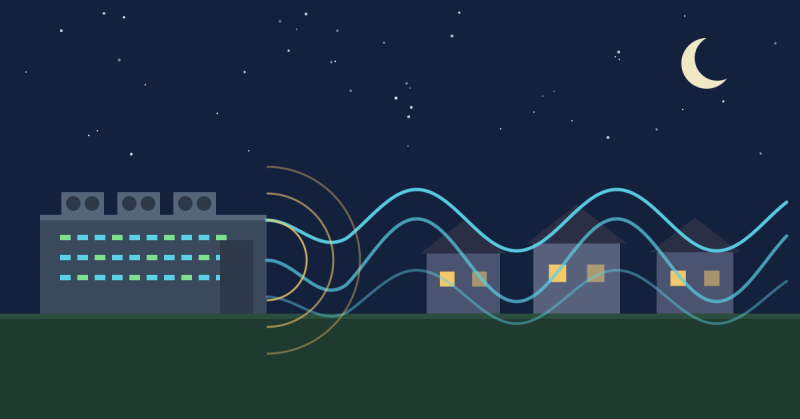
Data centers power much of modern life, but for some of the people who live nearby, they may come with a constant low hum that is hard to ignore and harder to escape. Here are plain answers to the questions people ask most, based on what the research does and doesn’t show.
What exactly is “low-frequency noise” in plain terms?
It is sound that vibrates slowly, giving a deep rumble rather than a high whine. A whistle vibrates thousands of times a second; thunder vibrates only a few dozen times. Data centers mostly make the thunder kind, from their big fans, pumps and cooling towers. The difference is that real thunder passes. A data center’s hum can sound like thunder that never stops.
Is 50 to 60 decibels actually loud?
By the numbers, no. That is roughly the level of a quiet conversation or a running refrigerator heard up close. But decibels don’t tell the whole story for this kind of sound.
A steady, low-pitched hum at 60 dB is far more intrusive than a 60 dB conversation. A conversation starts and stops. The hum is there 24/7 and can stand out most at night, when everything else goes quiet and people are trying to sleep. On top of that, the standard dBA scale undercounts low frequencies, so the number on a sound meter can understate what people actually experience.
For comparison, the World Health Organization recommends keeping road traffic noise at night below 45 dB outside homes to avoid harming sleep. The US Environmental Protection Agency’s long-standing benchmark is 55 dB outdoors averaged across the day. Many data center neighbours live at or above these levels. It’s not about how loud the noise is; it’s about how impossible it is to escape.
Why does this kind of sound travel so far and get through walls?
Because its waves are so long. 50 Hz has a wavelength of about 7 metres (roughly 22 feet). Waves that long bend around buildings, fences and hills instead of being stopped by them. They also lose very little energy as they move through the air, so they carry much further than higher-pitched sounds, which fade quickly with distance.
Walls and windows struggle too. Ordinary building insulation is designed to stop voices and traffic, not deep rumbles. A low-frequency wave can make a whole wall or window pane flex slightly, passing the sound inside. In some rooms, the sound can even make the air inside “resonate”, like the body of a drum, so the hum seems louder indoors than out.
How far it travels depends heavily on the site, the equipment and the weather. Residents in some places report hearing or feeling the hum more than a kilometre away, and under the right conditions it may carry several kilometres. Good, site-specific measurements are still scarce, so these distances should be seen as reports rather than firm rules.
Health effects
Is this noise making people near data centers sick?
It depends on what you mean by “sick”. There is strong, consistent evidence that constant low-frequency noise disrupts sleep, raises stress, causes headaches for some people and makes it harder to concentrate. Reviews of the research going back two decades keep finding the same pattern, and that is real harm to people’s daily lives.
What we don’t yet have is strong evidence that this noise directly causes chronic diseases such as heart disease, at least at the levels typical near homes. The research on that question is still limited. So the best evidence is for sleep and stress, not for long-term disease, at least not yet.
How does it actually disrupt sleep?
Your brain keeps listening to your surroundings even while you sleep. That is a survival feature: it is why a parent wakes when a baby cries. A hum that never stops and never changes is exactly the kind of thing the brain has trouble filing away as “safe”.
People describe taking longer to fall asleep, sleeping more lightly, waking more often and feeling less rested in the morning. This can happen even when the noise never fully wakes them. Over weeks and months, poorer sleep can feed into tiredness, low mood and irritability.
Can this cause heart disease or other serious conditions?
Possibly, but the link has not been proven for data centers. Long-term exposure to general environmental noise, especially road and aircraft noise at night, has been linked to higher blood pressure and heart risk. The main pathway appears to be disturbed sleep and a raised stress response, which over years can strain the blood vessels.
It is reasonable to ask whether data center noise could work the same way. But the studies behind those findings looked at traffic and aircraft, not at the steady hum of a data center. Until researchers study this directly, it is important not to overstate the risk.
Are people imagining this, or is it psychological?
No, the sound is physically real and can be measured, and people’s reactions to it are real too. But sensitivity varies from person to person. Someone with existing sleep problems or anxiety, or who lives in a very quiet rural area, will notice the same hum far more than someone else.
That isn’t “all in their head”. How disruptive a sound feels depends on both the sound itself and how the brain interprets it. It is not imaginary, and it is not universal; both things are true at once.
Why can’t people just get used to it, or tune it out?
Think of a dripping tap. It is barely noticeable at first, but after an hour it can be hard to think of anything else. Our hearing is tuned to flag continuous, unchanging sounds, because in nature they often signalled something worth paying attention to.
A steady hum gives the brain nothing to “resolve”. It never ends and never turns out to be harmless, so the brain keeps monitoring it in the background. That constant low-level vigilance is mentally tiring, and for some people annoyance grows over time rather than fading.
What makes it worse
Does weather or wind make this worse for nearby homes?
Yes. When the wind blows from the facility towards homes, it carries the sound further and more strongly. Cool, still nights can be worse still. On those nights, a layer of warm air can sit above cooler air near the ground, a pattern called a temperature inversion. It acts like a lid, bending sound back down so it travels further and seems louder than during the day.
Night-time is harder in general, simply because traffic and daytime activity have stopped. With nothing else to mask it, the hum becomes the loudest thing in the room.
Are some people or some homes more affected than others?
Yes. Terrain matters: valleys and open, flat land can channel sound towards a neighbourhood, while hills and dense buildings can sometimes shield it. Construction matters too. Because low-frequency sound passes through walls easily, older or lightweight homes, such as timber-framed houses with single-glazed windows, may give less protection than people expect.
People differ as well. Shift workers who sleep during the day, people with sleep or anxiety disorders, and anyone who works from home spend more time exposed and may be more affected.
Solutions
Can data centers actually be made quieter, or is this just the cost of living nearby?
They can absolutely be made quieter. The most effective fix is usually the cooling system itself: larger, slower, variable-speed fans in place of small fans running flat out. Beyond that, the main tools are:
- acoustic enclosures and barriers around the noisiest equipment;
- vibration isolation, so sound doesn’t travel through the ground and the building’s structure;
- silencers on air intakes and exhausts;
- pointing equipment and exhausts away from homes;
- leaving more distance between the facility and houses;
- ongoing noise monitoring, including low-frequency (dBC) measurements, not just dBA.
Even a 5 to 10 dB reduction makes a real difference. Because the decibel scale is logarithmic, cutting 10 dB is roughly perceived as halving the loudness. This is an engineering problem with engineering solutions. It is also far cheaper to design quiet equipment from the start than to retrofit it after neighbours complain.
Will planting trees or building a wall around the facility fix it?
Not on their own. Trees help a little with higher-pitched sound and give a welcome visual screen, but they do very little against low-frequency noise because the waves are simply too long. A plain wall has the same limit: a 7-metre wave bends straight over or around it.
A large earth mound (a berm) combined with a wall works better, but the real fix is quieter equipment at the source.
What should someone do if they’re already hearing this noise from a nearby facility?
Start by keeping a simple noise diary: the dates, times, weather and how the noise affects you. Then raise it with the operator and your local council or environmental regulator, who can arrange measurements. Ask that measurements include low-frequency readings, not only standard dBA.
On the facility’s side, there are usually practical options short of anything drastic. These include identifying which specific piece of equipment is the main source, adding silencers to intakes and exhausts, isolating vibration, enclosing the noisiest units or adjusting how equipment runs overnight. Many communities have seen real improvement once the source was pinpointed. Targeted fixes tend to work better than trying to reduce everything equally.
The Bottom Line
So, yes or no: is data center noise a health hazard?
It is a well-documented quality-of-life and sleep problem for people who live nearby, and that alone deserves to be taken seriously. What it is not, at least on the evidence we have so far, is a proven cause of chronic disease at typical residential levels. It matters to be precise about that, rather than rounding the risk up or down.
Some recent reports from very large facilities describe much higher noise levels, and residents reporting dizziness, nausea and headaches. These cases sit at the extreme end of the range and deserve investigation, but they are not the typical experience. More independent research, especially measurements of low-frequency sound and infrasound around real data centers, is clearly needed.
The noise is real; it affects people’s sleep and stress, and it is very solvable. The technology to build quieter data centers already exists; it’s a question of using it.
At a glance
| Topic | Key point |
| What it is | A continuous low, rumbling hum from cooling fans, pumps, cooling towers and transformers |
| Typical level at homes | About 40–60 dBA: quiet on paper, but constant and tonal, so it feels worse than the number suggests |
| Strongest evidence | Sleep disruption, stress, annoyance, headaches, poorer concentration |
| Weakest evidence | Direct causes of chronic disease such as heart disease |
| Made worse by | Wind towards homes, temperature inversions, night-time quiet, open terrain, lightweight homes |
| Best fixes | Quieter variable-speed fans, enclosures, silencers, vibration isolation, distance, monitoring |
| Least effective fixes | Trees or plain walls alone, because the waves are too long to block |
Sources
This article draws on the following references. Figures are approximate.
- World Health Organization, Environmental Noise Guidelines for the European Region (2018).
- US Environmental Protection Agency, Information on Levels of Environmental Noise Requisite to Protect Public Health and Welfare (1974).
- Baliatsas et al., “Health effects from low-frequency noise and infrasound in the general population: Is it time to listen?”, Science of the Total Environment (2016).
- Leventhall, H., “Low Frequency Noise and Annoyance”, Noise & Health (2004).
- Araújo Alves, Neto Paiva, Torres Silva and Remoaldo, “Low-Frequency Noise and Its Main Effects on Human Health: A Review of the Literature 2016–2019”, Applied Sciences (2020).
- Münzel, Sørensen and Daiber, “Environmental Noise and the Cardiovascular System”, Journal of the American College of Cardiology (2018).
- Miguel Yañez-Barnuevo,”Environmental and Energy Study Institute, “Communities Are Raising Noise Pollution Concerns About Data Centers” (March 23, 2026).
- The Conversation, “5 ways data centers endanger their local communities” (2025).
- McCunney et al., expert review of wind turbine noise and health (2014).

No responses yet