
 RESONANCE RESEARCH INSTITUTE
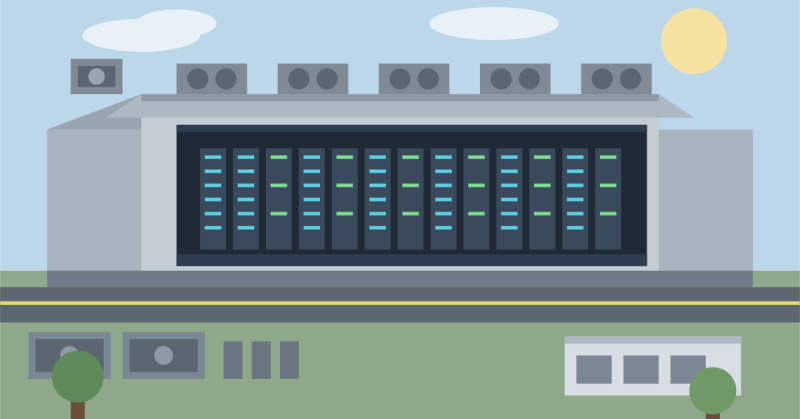
People living near data centres often describe the same thing: a low, rumbling hum that is never very loud, but never goes away. Here is what that sound is, why data centres make it, and what the science says about its effect on health.
The noise near a data centre is real, and the strongest evidence links it to poor sleep, stress and annoyance rather than to long-term disease. The good news is that it is largely an engineering problem, and engineering can fix it.
As the internet, cloud storage and artificial intelligence grow, data centres are being built closer to homes than ever before. Many neighbours are fine with them. But in some communities, residents say the steady drone has changed how they sleep and how they feel in their own homes. As one way of putting it goes: this isn’t about whether the noise is loud; it’s about whether it ever stops.
What is low-frequency sound?
Low-frequency sound is the deep, rumbling end of what we hear: think thunder, a bass drum or an idling truck rather than a whistle. All sound is simply vibration travelling through the air. How fast the air vibrates is called the frequency, measured in cycles per second, or Hertz (Hz).
A healthy young ear hears from about 20 Hz up to 20,000 Hz. High-pitched sounds like a smoke alarm vibrate thousands of times a second. Low-pitched sounds vibrate slowly, and acousticians usually call anything between roughly 20 and 200 Hz “low-frequency”. Below 20 Hz is infrasound: most people can’t hear it as a tone, but at high enough levels it can be felt as pressure or vibration.
| Sound | Approximate frequency | Wavelength in air |
| Smoke alarm | 3,000 Hz | about 11 cm |
| Human voice | 100–1,000 Hz | 0.3–3.4 m |
| Electrical transformer hum | 100 Hz (Australia) or 120 Hz (US) | about 3 m |
| Large fan or engine rumble | 30–80 Hz | 4–11 m |
| Lowest audible note | 20 Hz | about 17 m |
| Infrasound | Below 20 Hz | more than 17 m |
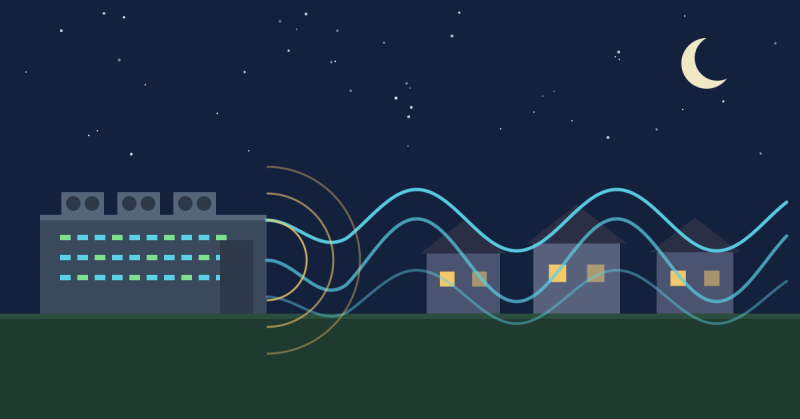
The last column matters most. A low-frequency sound wave is long, often longer than a house is wide. As we will see, that one fact explains why this sound travels so far, slips through walls and is hard to block.
There is one more quirk. Noise is usually measured in “A-weighted” decibels (dBA), a scale designed to match how our ears hear everyday sounds. It deliberately discounts low frequencies, so a reading in dBA can make a deep hum look quieter than it feels. Specialists often add a “C-weighted” reading (dBC), which counts the low end more fully.
Do data centres produce low-frequency sound, and why?
Yes. Much of a data centre’s outside noise sits in the low-frequency range, and it comes mainly from keeping thousands of computers cool. Servers turn almost all the electricity they use into heat, and that heat has to be pumped out of the building around the clock.
The main sources are:
- Cooling fans and chillers. Rooftop and yard units use large fans that move huge volumes of air. Each time a blade passes, it pushes the air, creating a steady low tone. Big, slow fans produce deeper tones.
- Cooling towers and pumps. These circulate water to carry heat away, adding a constant rumble and vibration.
- Transformers and electrical equipment. These hum at twice the mains frequency: 100 Hz on Australia’s 50 Hz grid, 120 Hz in the US.
- Backup diesel generators. They usually run only during tests or power cuts, but when they do, they are loud and very low-pitched.
Three features make data centre noise different from most neighbourhood sounds. It runs 24 hours a day, 7 days a week, because the computers never switch off. It is often tonal, meaning it has a distinct pitch, like a note being held, rather than a mix of random sounds. And it changes very little, so there is no natural break for the ear.
The exact frequencies vary from site to site, and published measurements are still limited. Most of the energy is thought to sit between a few tens of Hertz and about 200 Hz, with some sites also producing infrasound. Measured levels at nearby homes typically range from 40 to 60 dBA, though some reports from very large facilities describe much higher readings at the property boundary.

No responses yet